

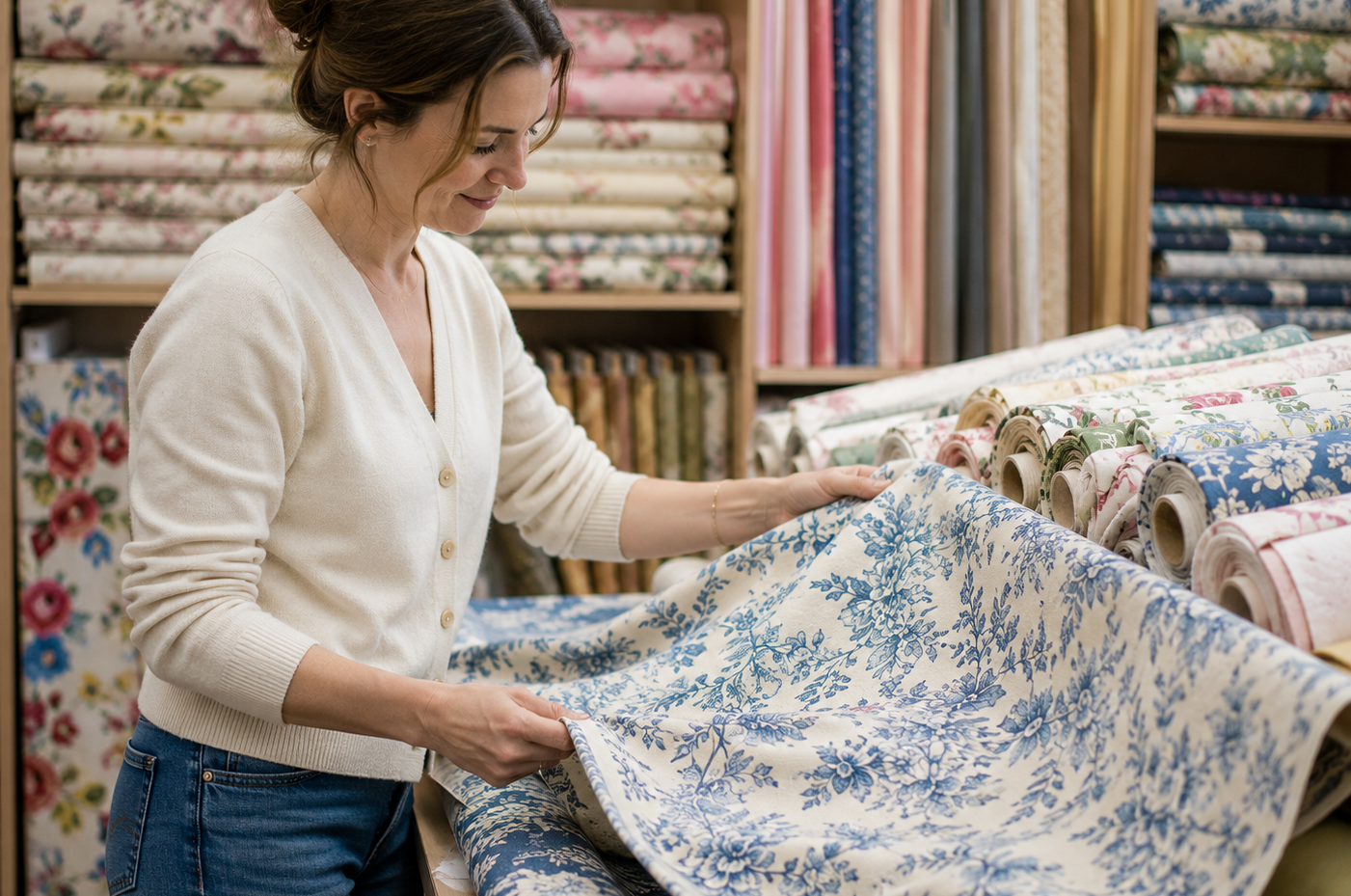
Everything a beginner needs to know about choosing the right fabric for lampshade making — answered in plain English. From the best materials to pattern placement, cutting tips, and how much to buy.
Table of Contents
I want to make a lampshade. Does the fabric really matter that much?
Yes — more than almost anything else. When it comes to fabric for lampshade making, it is the first thing anyone sees and the last thing you touch before the shade goes on the lamp. Choose the wrong one and you’ll fight it the entire way through the project: it will slip when you try to laminate it, fray at the edges, or look flat and lifeless when the light is switched on. Choose the right one and the whole process feels surprisingly smooth. It’s worth taking the time to get this decision right before you buy a single thing.
What makes a fabric suitable for lampshade making? What should I be looking for?
There are four things that matter for choosing the right fabric for lampshade:
How much light it lets through. Lightweight fabrics like cotton and linen allow a warm, diffused glow. Thicker fabrics like velvet block most of the light and create a more dramatic, moody effect. Neither is wrong — it depends on the mood you want the lamp to create.
Whether it holds its shape. Fabric that stretches or sags will warp on the frame. You want a woven fabric with a firm, stable hand — meaning it feels relatively crisp and doesn’t pull out of shape when you handle it.
How it behaves with heat. Synthetic fabrics like polyester and nylon can scorch near a hot bulb. Stick to natural or natural-blend fabrics: cotton, linen, silk, or cotton-linen blends as the fabric for lampshade. Always use an LED bulb too — it produces far less heat than a traditional incandescent.
How easy it is to cut and handle. For a first project, avoid fabrics that fray badly or slip around on the table. You want something that cuts cleanly and stays where you put it.
What is the best fabric for lampshade making if I am a complete beginner?
These 3 are the ones to start with:
Cotton is the all-round winner. It’s widely available, affordable, comes in every colour and pattern imaginable, doesn’t fray easily, and bonds perfectly to self-adhesive PVC backing. It’s forgiving of small errors, which matters a lot when you’re learning.
Linen has a beautiful natural texture that looks elegant on a finished shade. It’s slightly stiffer than cotton, which actually makes it easier to wrap neatly around a drum frame. Even a plain linen looks refined because of the subtle irregularity of the weave.
Cotton-linen blend sits between the two and is the sweet spot for many beginners — the softness of cotton with the structure and texture of linen. If you can find a fabric you love in a cotton-linen blend, use it.
What about velvet, silk, or satin? Can I use those?
Yes — but not for your first project. These fabrics can create stunning lampshades, and silk in particular allows light to pass through it beautifully. The problem is that they require a higher level of precision: they slip during lamination, they mark easily if you handle them too much, and they are less forgiving if your cutting isn’t perfectly straight. Build your confidence with cotton first, then explore the more luxurious options once you’ve made one or two shades and understand how the process works.
Are there fabrics I should definitely avoid?
Yes. These are the ones to stay away from:
- Jersey, stretch, or knit fabrics — they’re impossible to keep taut and will distort on the frame
- Loosely woven or open-weave fabrics — without a tight weave, the internal structure of the shade can show through
- 100% synthetic fabrics (polyester, nylon) — they pose heat risks and don’t adhere well to self-adhesive PVC
- Waterproofed or treated fabrics — any fabric with a water-resistant coating won’t bond properly to the adhesive backing, no matter how hard you press
I keep hearing about “self-adhesive PVC” for lampshade making. What is it and do I really need it?
Self-adhesive lampshade PVC is the structural backbone of a modern drum lampshade. It’s a thin, rigid sheet with a peel-off release paper on one side and a sticky surface on the other. You peel back the paper and laminate your fabric directly onto it — no sewing, no gluing the fabric to a frame. The PVC gives the shade its cylindrical shape; the fabric gives it its look.
For beginners making drum lampshades, it’s essentially the standard method now, and for good reason. The PVC is already fire-resistant and meets safety regulations. It’s also anti-yellowing and UV stabilised, so your fabric colours won’t fade over time.
For most shades, a 300 micron Standard Range PVC is the right choice. If you’re making a very large shade (50 cm diameter or over), step up to the 400 micron Premium Range for extra rigidity.
How much bigger does my fabric need to be than the PVC panel?
This is one of the most important practical questions, and it trips up almost every beginner at least once when choosing fabric for lampshade.
Your fabric must be at least 1.2 cm/0,6 inches larger than your PVC on every single edge — top, bottom, left, and right. This overlap is what you fold over and tuck to the inside of the shade to create a clean, finished border. If your fabric is the same size as the PVC, or only fractionally larger, you’ll have raw exposed edges on the finished shade and nothing to grip when tucking.
In practical terms: if your PVC panel is, say, 20 cm tall and 60 cm wide, your fabric should be cut to 22.4 cm tall and 62.4 cm wide (adding 1.2cm/0,6inches on each side in both directions).
The best habit is to cut the PVC first — using the grid on the backing paper — then lay it on your fabric, mark 1.2 cm beyond the PVC edge on all four sides with a soft pencil, and cut the fabric to those marks. Never cut the fabric and PVC to the same dimensions.
How much fabric should I buy? I don’t want to waste money but I also don’t want to run short.
It depends on your fabric’s pattern:
Plain fabric or a very small all-over print (fine dots, tiny stripes): Buy just enough to cover your PVC panel with the 1.2 cm seam allowance added on all sides. No extra needed.
A medium-scale pattern (motifs up to around 15 cm): Buy at least twice the minimum you’d technically need. The extra fabric gives you the freedom to slide the panel around until the design is positioned exactly where you want it before you commit to cutting.
A large-scale pattern or a specific motif you want to feature (motifs over 30 cm, or a printed fabric with a central image you want centred on the shade): Ask the fabric shop for the pattern repeat measurement and buy at least 1.5 times the repeat on top of your base requirement. This ensures you can work with a complete, unbroken version of the motif.
It always feels wasteful to buy extra, but fabric is far cheaper than the time you lose if you cut in the wrong place and have to start again.
I’ve chosen a patterned fabric for lampshade. Does it matter where on the pattern I cut?
Enormously. This is the thing that separates a professional-looking shade from one that looks homemade. A pattern that’s been thoughtfully placed looks intentional and beautiful. A pattern that’s been cut wherever it happened to land looks careless, even if the fabric itself is stunning.
The general rule is that the main visual element of your pattern should sit in the vertical centre of the shade — roughly at eye level when the lamp is on a table or sideboard. This means the most interesting part of the fabric is the first thing you see.
Horizontally, you want the pattern to either meet neatly at the back seam, or at least be balanced enough that the join isn’t obvious. Never position the strongest part of a motif right at the seam line, where it will be interrupted.
How do I choose the right pattern size for my shade? I’m worried about it looking wrong
Match the scale of the pattern to the size of the shade. This is a simple rule but it makes a significant difference to the final result.
Small shades (under 20 cm diameter) work best with small, delicate patterns — ditsy florals, fine stripes, small geometric repeats. A large bold print on a small shade will look cluttered, and you’ll probably only see one or two motifs at a time anyway.
Medium shades (20–35 cm diameter) are the most forgiving. Medium-scale patterns work beautifully here — florals with motifs around 5–10 cm, classic toile, medium geometrics.
Large shades (over 35 cm diameter) can carry bold, oversized prints with confidence. A dramatic large-scale floral or a wide graphic stripe looks exactly right on a big shade. On a large shade, a tiny all-over pattern can actually disappear and look fussy rather than delicate.
A useful rule of thumb: the pattern repeat should be no larger than one-third of the shade’s height. This ensures you can see at least a full repeat on the shade without it feeling overwhelming.
Will my fabric look different once the lamp is switched on?
Yes, often quite dramatically — and it catches a lot of beginners off guard. Fabrics change in colour and tone when light shines through them from behind. A deep navy can look much lighter and more blue when backlit. A warm terracotta can glow a rich, beautiful orange. Dark colours become more translucent than they appear in the shop. Very pale colours can look almost luminous.
Before you buy your fabric for lampshade — or at least before you cut — hold the fabric up to a light source. A window works well, or hold it over a switched-on desk lamp. Look at the colour, the pattern, and how much light comes through. What you see is very close to what you’ll get with the lamp on. This quick test has saved many a lampshade maker from an unpleasant surprise.
Quick summary — what is the most important thing to remember when choosing fabric for a lampshade?
Buy more fabric than you think you need, and plan before you cut. The two most common beginner mistakes are cutting the fabric too small (forgetting the 1.2 cm seam allowance on all sides) and cutting without thinking about pattern placement first. Both mistakes cost money and time. Both are completely avoidable with five minutes of planning. Do the maths, do the Paper Window Trick, mark everything with a pencil — and then cut the fabric for lampshade with confidence.
No responses yet